Dear friend,
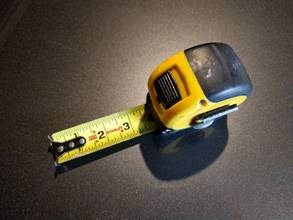
Whether you do your own remodeling work or just hang an occasional picture you have likely used a tape measure. Since they don’t come with a manual you may have overlooked some of the features pros use. Attached is a list of helpful features that may surprise you.
For those who wish to leave the tape measure to the pros, I have a list of contractors and handy men I can refer. Just give me a call.
Sincerely,

Windermere Real Estate
425-765-2211
By the way, if you know someone who would like help with purchasing or selling a home or need a referral to a qualified service provider please give me a call with their name and number. I’ll be delighted to help.
Special note: The first 10 people who call me about this letter will receive a FREE tape measure! Now you too can measure up.
Tape Measures
Not all tape measures are the same and may not contain all the features or markings discussed below. Some are designed around the metric system and others around the imperial system. Some have both. Some are narrow and some are wide. The professionals like the wider ones because of what’s called “stand out”. Stand out refers to how long the tape will remain stiff until it bends, this helps when working alone.
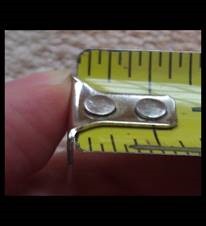
Most tapes will have a floating hook on the end that can be hooked onto the edge of what you are measuring. The hook floats a distance equal to its thickness to provide accurate inside and outside measurements. Many pros will measure starting at the 1” mark to avoid this floating feature and get a more accurate result, just remember to subtract an inch from the final measurement if using this trick.
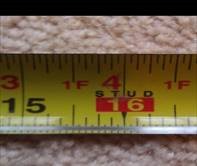
Some tapes have markings designed around common construction measurements. These marks can be a simple arrow or diamond or in this picture the word “stud”. Most walls have studs at 16” On Center “OC” referring to the middle of each stud.
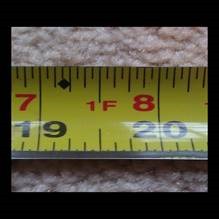 There’s also a 19.2″ ceiling joist measurement. Like studs, they are spaced with OC measurements. The reason for this odd 19.2″ measurement is similar to the reason for the 16″ stud measurement; it divides evenly into an 8′ span, which is typical for American building materials. A 4’x8′ piece of plywood will span 6 joists, and a 4’x8′ piece of drywall will span 7 studs (or 4 studs if you’re hanging vertically). If the math looks funny to you, make sure you remembered to count the first stud/joist at the 0″ mark.
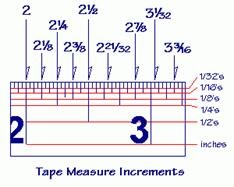 Most tapes have increments as small as 1/32”. Sometimes these are written out but mostly they will just be a series of progressively smaller lines. If they aren’t written out, just remember that each smaller line is ½ of the previous one.
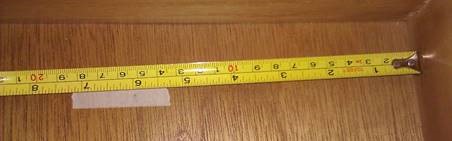 Here’s a great trick. Place masking tape on the object you are measuring and transfer the markings from the tape to the masking tape for greater visibility and accuracy.

